JJ Litke

the neural pathways less traveled

  • Home
  • Contact Me
  • Published Work
  • Blog

Creating races in fiction: primate skulls

February 12, 2015 by JJ

So you’re creating a fantastic world for your story. Naturally, you want to populate it with fantastic beings. To pull this off, those beings still have to follow certain rules of anatomy and physics (unless you’re making up your own physics, in which case, good luck). Even if readers don’t fully understand the anatomy of real-world creatures similar to yours, they very well might realize something is amiss without knowing precisely why–people can be pretty damn smart, and you want smart readers, right? Okay then.

This is an extremely broad subject, so I’m going to tackle a small detail to make my point: primate skull shapes. This came up while at the Smithsonian National Museum of Natural History with my daughter. Being the full-time badass she is, she threw out details and facts throughout. When we got to a display of small primate skeletons, she noted how some are smoothly rounded, like a human’s, and some had bony ridges across the top.

You know what a human skull looks like, so let’s look at something cute, like a spider monkey.
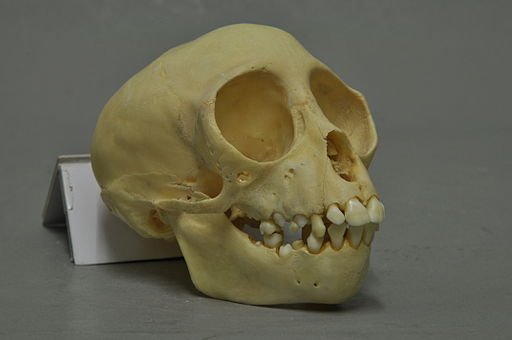
spider monkey, spider monkey, doing the things a spider monkey can
By Klaus Rassinger und Gerhard Cammerer, Museum Wiesbaden (Own work) [CC BY-SA 3.0 (http://creativecommons.org/licenses/by-sa/3.0)], via Wikimedia Commons
Aw, kind of. Okay, a skull isn’t as cute as a live monkey.

The skull is rounded, with wide open eye sockets. No bony ridges on top. Spider monkeys–and humans–have smooth skulls because we have weak little flappy jaw muscles that don’t need much room to anchor to the skull.

By contrast, here is a mandrill skull. The stronger the jaw muscles, the more room they need to attach to the skull (or else they’d tear off of the skull under their own power). The bony ridges (which you can just see on the back of the skull) allow more surface area for the jaw muscles to attach.
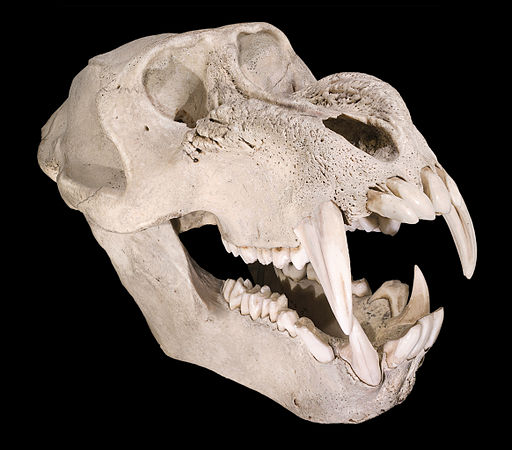
mandrill skull: death awaits you with nasty big pointy teeth
By Didier Descouens (Own work) [CC BY-SA 4.0 (http://creativecommons.org/licenses/by-sa/4.0)], via Wikimedia Commons
That guy? Can bite your arm off.

Wait, it gets better. Have you ever noticed how pointed a gorilla’s head is? It’s because they have FREAKING HUGE bony ridges. Which means REALLY POWERFUL JAWS. They need all that extra skull square footage for those massive muscles.
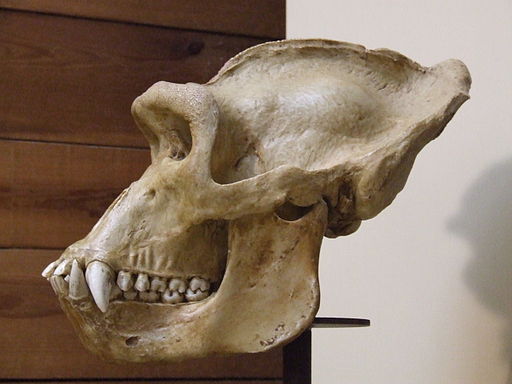
I'll bite yer legs off
By Panellet (Own work) [Public domain], via Wikimedia Commons
Side note, if you’d like to become the proud owner of a gorilla skull replica, click here to go to a fun site that sells real and replica bones. (Be sure to check out the Gift Finder link! Seriously, they have a Gift Finder link in the left nav bar.)

You might also notice that the skulls of primates with the large bony ridges associated with jaw muscles also have larger brow ridges. This has to do with the muscular structure of the head, and it’s going to affect the overall appearance of the animal.

The physiological appearance of animals is dependent on their underlying structure. Primates with powerful jaws have a distinctive appearance. So if you wanted to make up a race of aliens that are humanoid, but have super strong jaws, they should look more like the basic gorilla structure than human. Same for any other unique cranial elements; you need to consider how that would really work and adjust their appearance accordingly. The same would also hold for other musculature, like if arms or legs were particularly strong, or if they had more than the usual number of limbs.

It’s subtle detail that’s important for a realistic touch. And you’re kidding yourself if you think readers wouldn’t notice if you didn’t do it right. People may not consciously know all of these details, but they know when something feels off. And they don’t like it.

Maybe I’ll tackle the physiology of snake skulls next. Don’t anyone hold their breath for that to happen quickly, though.

Filed Under: Writing Tagged With: characters, fantasy, writing

We suck at relationships

March 12, 2014 by JJ

I have a fascination with Confucianism. That shows in my writing, though you wouldn’t notice if you aren’t familiar with it yourself. And most people aren’t.

I should clarify that Confucianism is non-theistic. Just so you know, I’m not peddling religion here. It’s an ethical system, primarily concerned with correct behavior, and even more primarily with behavior toward other people. This where that relationships thing comes in. According to Confucianism, there are five basic relationships, which I will list without strict regard for political correctness:

  • Ruler to subject
  • Parent to child
  • Husband to wife
  • Elder sibling to younger sibling
  • Friend to friend

Within these relationships, the person in seniority has a moral obligation to behave with benevolence toward their juniors. That means looking out for their well being and generally taking care of them. The person in the junior position should treat their seniors with respect. As any given person could be in multiple of these relationships at the same time, they would adjust their behavior and expectations toward others depending on those relationships.

A great example of how this thought process works is two brothers with two apples, one large and one small. The elder brother offers the younger brother the large apple because he is still growing. But the younger brother offers the elder brother the larger apple because he is bigger. Aw!

That’s a lovely philosophy, isn’t it? Just a couple of problems, though. While Confucianism is fairly clear that one should know one’s place and stick to it (and that’s a pretty huge problem on its own), it’s a lot less clear about what to do when the other person in the relationship isn’t following the philosophy. But in general I think we can agree that a lot of us really suck at following these general guidelines, at least on a regular basis (certainly the Tea Party doesn’t ascribe to the concept of caring for others). It’s still a good goal, and a good way to think of how we should be acting toward others who depend on us.

Circling back to my writing (you knew I’d do that, didn’t you), all of those relationships are represented in my books. I actually didn’t consciously plan it that way, it just made sense because I deal with a lot of family issues and relationships. Just like in real life, my characters don’t always behave as they should. Yet even the most selfish of my fictional family still see their obligation to look out for their people. They would never deny food or shelter to those who depend on them. If I did write them that way, my story would be foolishly unbelievable.

Funny how real life can be more twisted and absurd than fiction.

Filed Under: Writing Tagged With: characters, family, morality, themes, writing

Immortal characters and the people they know

October 20, 2013 by JJ

If someone lived long enough, they must have met some interesting historical figures, right? Famous names that anyone now would recognize. It just makes sense that it works that way, and it’s big fun to read those bits of alternative history in fiction. It’s even more fun to write them. Which is the only good reason to do it, because it’s definitely not realistic.

It really only makes sense if you don’t look too close or think too much about it. It turns out that many names we recognize as famous now were pretty far from that when they lived. In the novel Hounded, the first of the Iron Druid Chronicles, the main character–who has been around for 21 centuries–mentions knowing Van Gogh. But Van Gogh was virtually unknown during his life. He sold exactly one painting. Only later was his work noticed, and even later to become the widely-known name that he is. But okay, let’s say that his work became famous later because this long-lived character (strictly, he isn’t a true immortal) knew him, and somehow contrived that postmortem fame. So, there we go, still plausible. Though to be honest, I’m not sure that’s really how the author meant it (Kevin Hearne, if you’d like to correct me on this, I’d appreciate it).

So some examples could be explained away. Some others, not so much. The very worst demonstration of this I can think of is from the movie Hancock. Criticizing Hancock is like shooting fish in a barrel, there’s just so much to vilify there. But I’m talking about the bit right at the very end, when Jason Bateman quizzes Charlize Theron about various historical figures: Attila the Hun, Queen Elizabeth (without specifying which Queen Elizabeth, I’m assuming the dead one), and JFK. She personally knows EVERY PERSON WHO EVER EXISTED and she has opinions on all of them.

Now I know what you’re thinking: with everything that went wrong with Hancock, THAT is the thing you chose to pick at? Well, yeah, odds are good you didn’t even notice that particular flaw after the more glaring stuff that came before it, and the lame heart-moon thing after. Besides, it fits today’s subject.

I admit, that pieces of alternate history like this are really enjoyable when done well. In my own writing, I decided to go the other direction. My characters (like Hearne’s, they are not truly immortal) have spent centuries trying to remain hidden. While they’ve interacted and even interfered plenty, they aren’t given to hanging out at the top with big names. That, logically, would ruin anonymity. My fave depiction of this is a young man meeting someone who is more than seven centuries old (I know, that’s a little on the young side). He could ask about anything he wants. Coming back to their conversation later, they’re talking about football. It’s unfortunately realistic; I imagine that, on the spot, you’d quickly run out of questions, especially if you got a number of responses like, “No, I never met him,” or “I wasn’t there, I don’t know any more than a history text would.” Then the conversation would naturally turn to the sorts of things that any two people might talk about. (Though actually, I think someone who’s been in as high a number of wars and conflicts as that character might have a fascinating view of football, and I would totally jump at the chance to find out.)

All that said, I’d like to get some more historical figure references as I continue through the Iron Druid Chronicles. I’m holding out hope that Hearne will fall into the doing-it-right category.

Filed Under: Reading, Writing Tagged With: books, characters, history, reading, writing

Recent Posts

  • Irregular Reviews: Midnight at the Houdini
  • Irregular Reviews: Everything Sad is Untrue
  • Easy Halloween Fence
  • 7 Tips For Sharing COVID—And The Holidays—With Your Family
  • UFO8 anthology, now with more JJ!

Follow via Email

Enter your email address and receive notifications of new posts by email.

Join 6 other subscribers

Cool sites that aren’t mine

  • Slugtribe
  • Submission Grinder

Recent Posts

  • Irregular Reviews: Midnight at the Houdini
  • Irregular Reviews: Everything Sad is Untrue
  • Easy Halloween Fence
  • 7 Tips For Sharing COVID—And The Holidays—With Your Family
  • UFO8 anthology, now with more JJ!

Copyright © 2026 · Author Pro Theme on Genesis Framework · WordPress · Log in


Loading Comments...